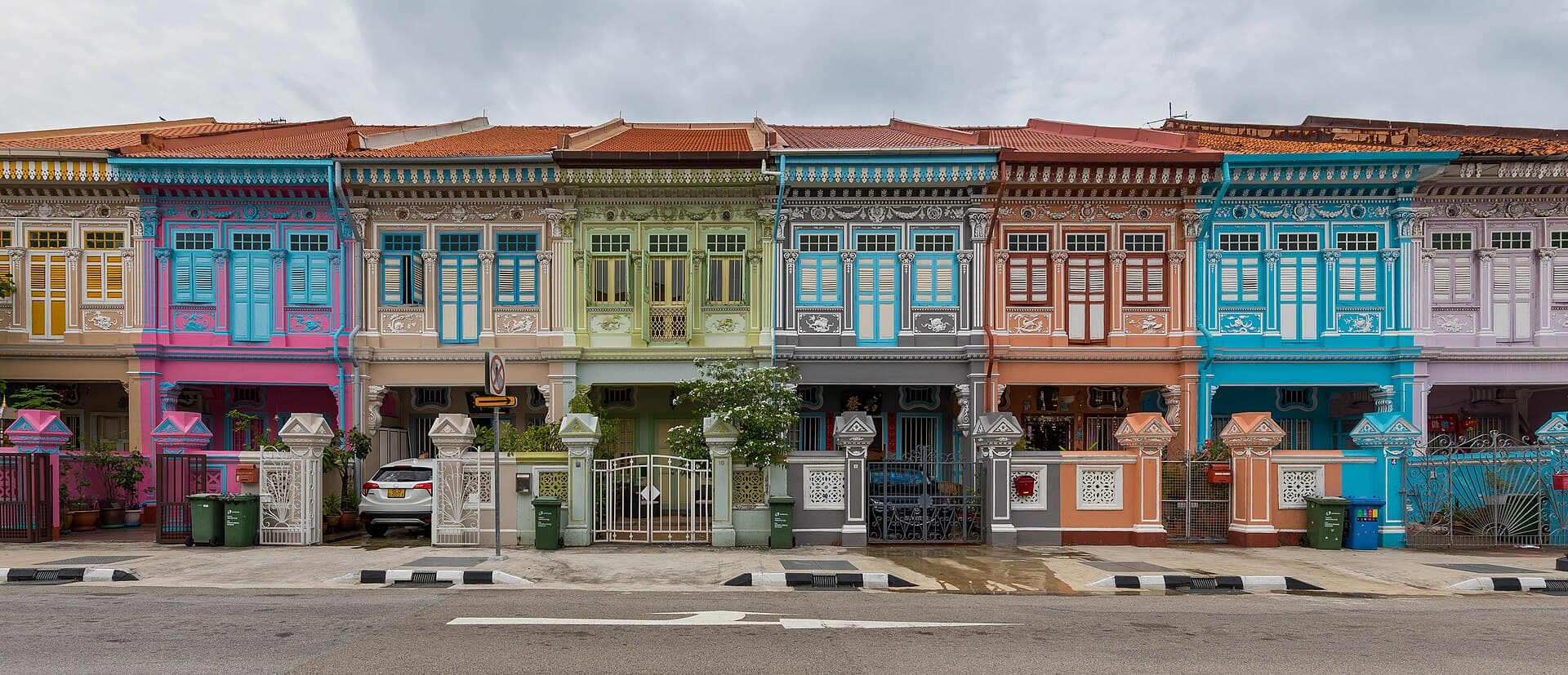
Koon Seng Road is the terrace that sold Joo Chiat to the internet: pastel shophouses, ceramic tiles, timber shutters, a Sunday light that makes every cornice look expensive. It is a real street, and it is a fraction of what people who live between Paya Lebar and the East Coast actually do with this neighbourhood. The rest is Joo Chiat Road’s mix of old businesses and new bars, East Coast Road’s laksa and kueh, and a conservation area that now shares its air well with short-term stays.
If you come only for the terrace, you will be done in fifteen minutes and slightly in the way. If you come as if you had an auntie off Joo Chiat Place, the day stretches: a market bag, a bowl of laksa, a look at the tiles, and a bus home that does not require City Hall.
The tiles were laid for houses. The cameras arrived later, and they do not get priority at the five-foot way.
Koon Seng Road is a residential street that became a set
Walk Koon Seng from Joo Chiat Road toward Still Road and you will get the famous row: green, pink, blue, the repeated plaster wreaths, the Peranakan tiles at skirt level. Look at the tiles properly. They are not a wash of colour; they are imported and local patterns, floral and geometric, some replaced, some original, some badly matched in a renovation that cared more about the Instagram elevation than the dado.
Then look at the doors. Some open on households. Some open on offices. A growing number sit on short-term rentals that turn the terrace into a weekend set for people who will not be here on Tuesday. Conservation rules kept the fronts. They did not keep the tenancy. That is the live argument in Joo Chiat: whether a gazetted shophouse street remains a neighbourhood when the upstairs is an Airbnb calendar.
Behave as if someone is home, because someone often is. Do not block the five-foot way for a couple shoot. Do not lean tripods in the road. Do not walk into a staircase to “see the tiles inside”. The pavement is public; the house is not. Early morning and late afternoon are kinder on the residents and on the light. Midday on a Sunday is when the street is at its most extracted.
The side streets — Joo Chiat Place, Everitt Road, Tembeling Road — are where the neighbourhood thickens. You get the less painted shophouses, the workshops, the churches, the old associations. This is closer to how the Joo Chiat–Katong belt worked when it was a Peranakan and Eurasian suburb rather than a brand.
Joo Chiat Road, East Coast Road, and a normal day
Joo Chiat Road is the high street, and it has never been only one thing. Kopitiams, drinking shops, money-changers, a few holdout trades, and a long slide toward bars and restaurants that fill after 8pm. In daylight it is errands. After dark it is a strip, especially on the stretch toward Marine Parade. Both uses are local. The late crowd is not imported in the Haji Lane sense; a lot of it still comes from the east. If you want that version of the night, our guide to eating after the last train is more use than another photograph of a shutter.
East Coast Road is where the food reputation actually sits. This is the Katong–Joo Chiat edge that people mean when they say they came for laksa: the shops that have been toasted and argued over for decades, the kueh counters, the bakeries, the seafood houses further toward the park. A weekday lunch is possible. A Sunday late morning is a queue. For the longer version of that habit, including which stretch of the road to walk, use the Katong laksa Sunday guide and do not try to eat three bowls out of anxiety.
Kueh is the quieter local purchase. The colourful steamed cakes in the glass case are for taking home, not for a tasting flight on the kerb. Buy a box, get on the bus, eat them with tea. Prices are still modest if you are not in a café that has redesigned the same kuih into a plated dessert. A few dollars buys a mixed set. That is closer to the domestic use of this neighbourhood than a S$22 cocktail on Joo Chiat Road.
Joo Chiat Complex, the unlovely mall at the Paya Lebar end, is where textile and household shopping still happens for a different demographic than the terrace walkers. It is air-conditioned and useful. It will not photograph. Include it if you came to understand the postcode rather than to complete a walk.
Conservation, Airbnbs and what the rules cannot do
The Joo Chiat conservation area was meant to hold the shophouse grain: two storeys, five-foot ways, the decorative fronts that made this one of the densest collections of Peranakan architecture left in Singapore. On that narrow measure it worked. The fronts are still there. What the gazette could not do is freeze the economics. When a restored shophouse is worth more as a short-stay or a restaurant than as a family flat, the family leaves, or never arrives.
You will see the evidence in lockboxes, in luggage on the five-foot way, in a Tuesday morning that feels like a set between bookings. As a visitor, stay in a proper hotel if you are passing through. If you are showing someone around, do not treat the terrace as an amenity you own because you have a camera.
Renovation quality varies. Some restorations are careful with the tiles and the timber. Others keep the colour and throw away the detail. Looking closely is allowed. Touching, leaning, and moving a potted plant for a cleaner frame is not.
The area is also a cycling neighbourhood in a way the terrace never advertises. East Coast Park is a straight shot south; the park connectors along the canal and the coast are how people here actually move on a Saturday if they are not in a car. The park connector network is the right frame for that, and a bicycle will teach you the grain of Marine Parade and Joo Chiat faster than circling Koon Seng for a parking space.
Buses versus Paya Lebar and Eunos
There is no Joo Chiat MRT station in the middle of the shophouses. Paya Lebar (EW8 / CC9) is the western approach: come out toward Paya Lebar Road and either bus down or walk Joo Chiat Road in the heat. Eunos (EW7) is the northern approach, useful if you are coming along the East–West Line and would rather bus 15 or 21 toward the east side of the grid. Neither station drops you on Koon Seng Road. Anyone who tells you it is “two minutes from the MRT” has not done the walk at 2pm.
Buses are the resident mode. Services along East Coast Road (10, 14, 16, 32 and others depending on the exact stop) will put you nearer the laksa and the kueh than any train. From town, a single bus ride is often less fussy than East–West to Paya Lebar plus a connection. From the north-east, Paya Lebar’s interchange with the Circle Line is the clean transfer.
Grab makes sense if you are carrying food home, if it is raining, or if you are moving a family at dinner. It does not make sense for a solo daylight walk that was supposed to be about looking at tiles.
Give yourself three hours for the terrace, a sit-down laksa, and Joo Chiat Road without rushing. Early is better for the residential streets; later is better for the eating street. Do not make Koon Seng Road do both jobs at 11am on a Sunday.
Joo Chiat still works as a neighbourhood when you use it as one: buy something that is not a souvenir, eat where the queue is local, walk the ugly useful buildings as well as the pretty ones, and leave the terrace quieter than you found it. The tiles will still be there. The people behind the shutters would like to be there too.