Pagoda Street is the Chinatown that arrives in the feed: red lanterns, souvenir magnets, a trishaw parked for a photograph, the smell of something sweet from a shop that opened last year. It is a real street, and it is a poor map of the precinct. Kreta Ayer — the older name, still used by people who live and work here — includes a Hindu temple older than the republic, a Buddhist temple that draws coach groups and aunties in the same hour, and a hawker floor upstairs at Chinatown Complex that has nothing to do with a fridge magnet.
If you live in Singapore and only come here for the Chinese New Year light-up, a weekday late morning will reset the scale. The souvenir strip is two or three pedestrian streets. The rest is South Bridge Road, Sago, Trengganu, the wet market under the complex, and the clan-association fabric that tourism walks past.
Smith Street sells the idea of Chinatown. The complex upstairs sells lunch.
Leave Pagoda Street for last
Chinatown MRT (NE4 / DT19) deposits you, if you take the obvious exit, onto Pagoda Street. That is the trap. Come up, turn toward South Bridge Road, and do the temples and the complex before you give the lane any time. The pedestrian streets — Pagoda, Temple, Smith — will still be there. They will not improve with a first impression.
Temple Street and Smith Street still have a few older businesses mixed into the souvenir run: medicine halls, a bak kwa shop that was here before the lanterns were a permanent installation, the stalls that sell the same plastic to every old town in Asia. You can walk them in ten minutes. You should not eat your only meal on them unless you have a reason. The food that still belongs to the neighbourhood is upstairs, or at Maxwell, or on the side streets that never got the paving treatment.
Mosque Street and Sago Street hold a different residue: the old death-house history on Sago Lane, the mosque that gives Mosque Street its name, the sense that this grid was never only Chinese and never only for show. Walk them without expecting a revelation at every door. A neighbourhood can be historical without performing it.
Club Street and Ann Siang Hill, a few minutes south-west, are the gentrified evening: bars, offices, a Friday crowd that does not think of itself as Chinatown. Useful to know. Not the morning’s work.
Temples that are still in use
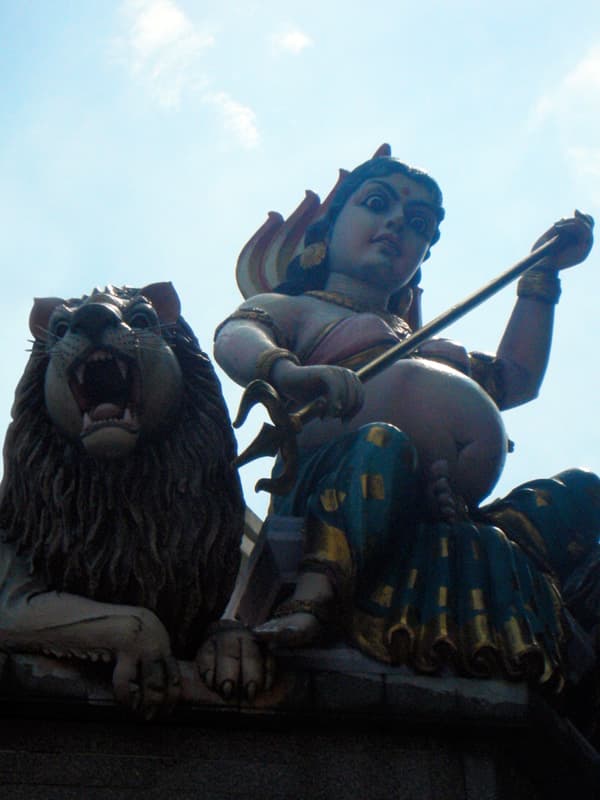
Sri Mariamman Temple on South Bridge Road is the oldest Hindu temple in Singapore, and it sits in Chinatown because this is where the city put a lot of its working communities, not because a planner wanted a multicultural postcard. The gopuram faces the road. The interior is a working courtyard of shrines. Shoulders and knees covered, shoes off, no wandering into the inner sanctum for a photograph. During ceremonies, stand back. The temple is used for weddings and for the fire-walking of Thimithi; those days are not a street festival you wander through with a drink.
Across the grid, the Buddha Tooth Relic Temple on South Bridge Road at Sago is newer, larger, and built to hold a relic and a crowd. It is free to enter, with the usual expectations: modest dress, a quiet voice, no flash where it is barred. The upper floors and the relic chamber have their own rules; follow the signs rather than the group in front of you. Coach tours arrive mid-morning. An earlier hour is kinder.
There are other temples and a mosque within a few hundred metres. The point is not to collect them. It is to notice that the souvenir street is bounded by buildings that still run a calendar of worship. When a procession takes South Bridge Road, the tourist lane is the interruption, not the main event.
Between the temples, the five-foot ways are the original covered walk. They are broken by renovations and by shops that have filled them with racks. Use them anyway. The alternative is the sun on South Bridge.
Chinatown Complex upstairs, and the market underneath
Chinatown Complex (the official name still trails through Kreta Ayer Community Centre and the market) is the building that saves the precinct from its own postcard. Ground and basement levels are wet market and the so-called thieves’ market of used goods — a Sunday and weekday mix of tools, electronics, and the kind of stall that has no interest in your holiday. Upstairs is one of the largest hawker floors in the country.
Go upstairs for lunch. The room is loud, cold from the air-conditioning, and organised in the way a big centre has to be: find a seat, order, return your tray. This is not a tasting street. It is a food centre that feeds the neighbourhood, the nearby offices, and the visitors who got good advice. Hawker etiquette applies without a Chinatown exception. Do not hover with a camera over someone’s fish soup. Do not ask a stall to pose the plate for a reel while the queue waits.
You will hear that a particular stall is famous. Some of them are, in the sense that they have a queue. A queue is information, not a verdict. There are dozens of other stalls. A plate of wanton mee or a bowl of herbal soup will cost you in the S$4 to S$8 band if you stay off the performance dishes. For chicken rice specifically, Maxwell Food Centre is the shorter, more argued-over room a few minutes toward the Maxwell Road junction — a different building, a different queue culture, and a walk you should do if that is the dish you came for.
The wet market under the complex is for shopping. Vegetables, poultry, dried goods, the shops that sell religious offerings. A weekday morning is the right time. If you only want to look, keep your hands off the produce and your body out of the stallholder’s working space. Vegetarian and no-pork eaters will find more options upstairs than the tourist menus on Pagoda Street suggest; this part of town has always cooked for more than one rule.
Kreta Ayer after the tour buses
Kreta Ayer, strictly, is the precinct around Kreta Ayer Road, Sago, and the community institutions that did not get a lantern installation. It is also a way of naming Chinatown when you want the residential and clan-association layer rather than the pedestrian mall. People’s Park Complex and People’s Park Centre, toward Eu Tong Sen Street, are the brutalist, still-used malls where the shopping is fabric, gold, luggage, and a food basement that has not been redesigned for visitors. Yue Hwa, the old department store on the corner, still sells the goods that overseas Chinese households actually pack.
Walk Eu Tong Sen and New Bridge as a pair of big roads that happen to have heritage on the side streets. The trishaws cluster where the cameras are. You do not need one. Chinatown is a compact grid; the MRT has two lines; the buses on New Bridge Road will take you out toward the east or north without theatre.
Evenings split. The souvenir streets stay lit and slightly sad after the day-trippers leave. Club Street fills. The hawker centres thin, then pick up again for dinner. If you want the late version — supper, a last drink, the walk to the train — the late-night eating guide is the better companion than another loop of Temple Street. Maxwell and some of the coffee shops keep later hours than the complex upstairs; check before you build a night around a single shutter.
A practical loop: Chinatown MRT, Sri Mariamman first, Buddha Tooth if they want the interior, Chinatown Complex for lunch, wet market if they will shop, Maxwell only if the chicken rice argument is already running, then Pagoda Street on the way back so nobody feels they missed the postcard. Two hours if you are efficient. Three if you queue.
What changed, versus the tourist Instagram, is the habit of treating the three pedestrian streets as the district. The district is the temples, the complex, the market, the clan buildings, and the people who still take the stairs to a plate of noodles that was never going to be photographed. Walk that first. Buy the magnet later, if you must.