Deepavali on Serangoon Road is a real event: lights, crowds, the annual photograph from the pedestrian bridge. It is also a poor introduction to Little India if it is the only one you have. The neighbourhood’s working hours are a weekday morning, when Tekka is a market, Buffalo Road is a wet street, and Sri Veeramakaliamman is receiving people on their way to something else. That is the version that still explains the place after the decorations come down.
Little India is not a theme park that opens for tourists and closes for residents. It is a commercial district that serves Indian Singaporeans, migrant workers from South Asia, and anyone else who wants spices, gold, a garland, or a thali. The mix shifts with the clock. Arrive at 8.30am on a Tuesday and you are in a produce economy. Arrive at 4pm on a Sunday and you are in a rest-day city that happens to use the same streets.
The festival lights are a season. The jasmine and the fish ice are the week.
Tekka, Buffalo Road and the weekday produce
Start at Tekka Centre, the block over the market at Serangoon and Buffalo. Downstairs is one of the city’s essential wet markets, in the same conversation as Tiong Bahru and Geylang: fish, mutton, curry leaves, okra, the brinjal that does not appear in a Cold Storage promotion. The floor is wet because it is a wet market. Wear shoes that can take it. Bring a tote. Point, or know the Tamil or Mandarin name if you have it.
Buffalo Road, running along the market’s flank, is the street-level version of the same trade. The name is a leftover from the cattle yards that were here when this was the edge of town. What remains is the smell of the market, the awnings, and a pavement that does not pretend to be a mall. Walk it before 10am. By late morning the sun is on the asphalt and the bargains have thinned.
Upstairs at Tekka is the hawker and the shops — fabric, brass, the stalls that have been argued over in food blogs for twenty years. You can eat here without making it a project. A vegetarian meal on a weekday, a fish-head curry if you came for that, a roti that is still a breakfast food. Prices are heartland prices if you stay with the trays: most plates under S$8, many closer to S$5. The vegetarian and no-pork map of hawker Singapore is useful if you are eating for religious or household reasons rather than for a dare.
Mustafa Centre, further up Syed Alwi Road, is the 24-hour exception everyone already knows. It is not a morning destination unless you need a suitcase or gold when nothing else is open. The weekday morning belongs to the market.
Temples, garlands and the working street
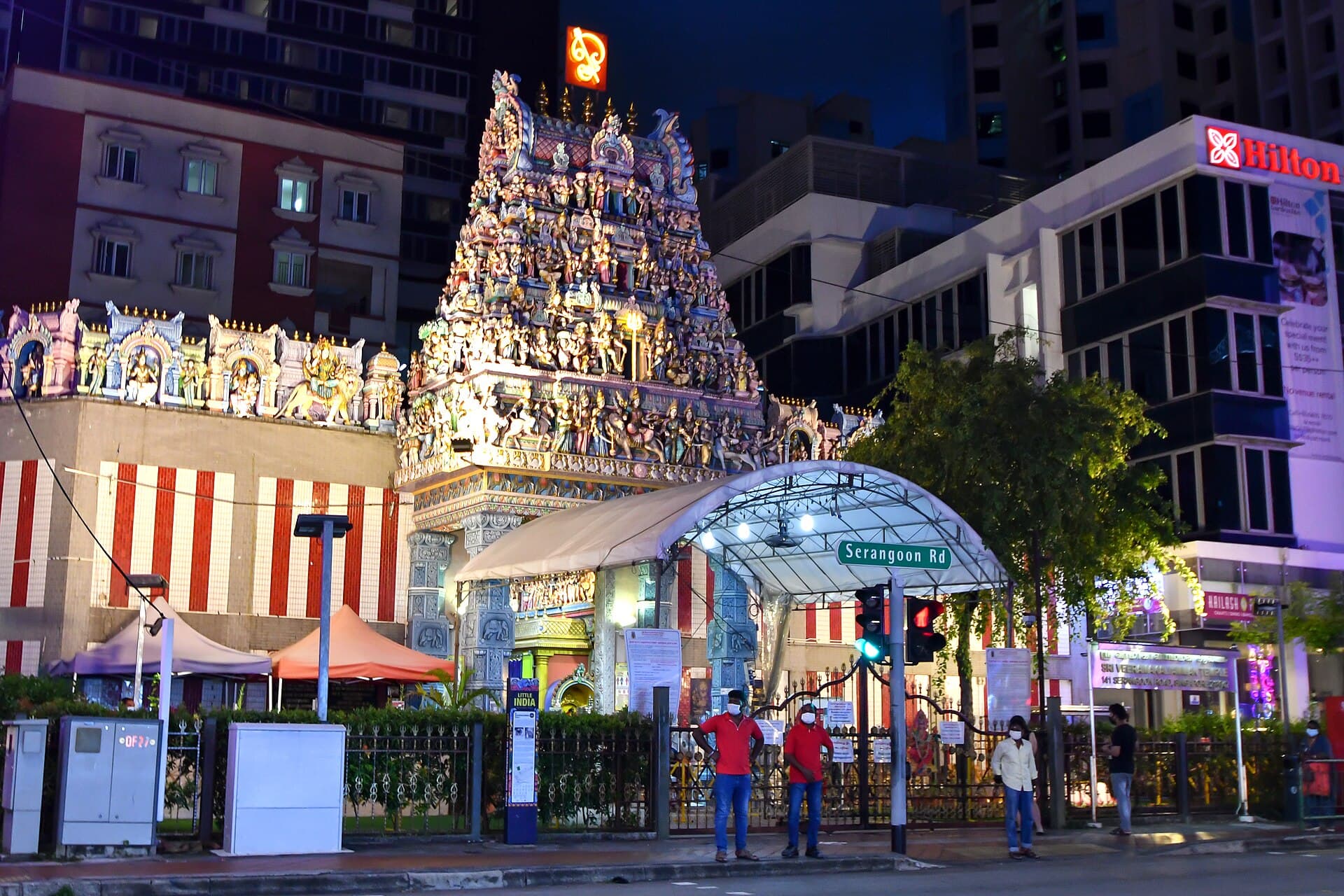
Sri Veeramakaliamman Temple on Serangoon Road is the gopuram in every establishing shot, and it is a functioning temple to Kali. People go in before work. They go in because someone is unwell. They go in because it is Tuesday. You may go in if you are dressed modestly, if you leave your shoes at the designated racks, and if you do not treat the inner sanctum as a viewing platform. A small donation box is not an entry ticket; it is a box. Photography of the tower from the street is normal. Photography of someone in prayer is not.
The flower sellers along Serangoon Road and the side lanes — Campbell, Dunlop, the stretches toward Race Course Road — are the weekday detail that the festival lights erase. Jasmine and rose, strung as garlands, sold to people who are going to a temple, a house, or a wedding. Buy one if you want one. Ask the price first; a simple garland is a few dollars, not a negotiation for sport. The uncles and aunties have a queue of regulars. Stand aside if you are only looking.
Further along, Sri Srinivasa Perumal on Serangoon Road and the other temples and churches in the grid remind you that this was never a single-faith street. The footpath is shared. So is the noise: traffic, film songs from a shop, a call from a doorway. Little India at 9am is loud in a domestic way. It is not a performance put on for the pedestrian mall.
Campbell Lane and Dunlop Street, between Serangoon and Race Course Road, still hold the shophouse grain: travel agencies, provision shops, the odd hotel, the shops that sell stainless steel tiffin carriers to people who will use them. This is a better walk than circling the most painted wall on a side street. Five-foot ways here are uneven and interrupted. Watch your step; watch the goods that spill onto the tiles.
Sundays are a different city
The large South Asian migrant workforce in Singapore — construction, shipyard, services — has Sunday, or part of Sunday, as rest. Little India is one of the places that rest concentrates. Race Course Road, Hampshire Road, the open grounds, the eating shops that stay packed from late morning: that is a civic fact, not a spectacle. The men are here because the city did not build them many other centres, and because this neighbourhood already spoke their languages.
A weekday morning is not that crowd. If you only came on a Sunday afternoon and found it “too much”, you met the rest day, not the market. Both are legitimate uses of the same streets. Only one of them is the produce-and-temple loop this piece is for. If you walk through on a Sunday, give people room, do not photograph groups as if they were scenery, and understand that you are on someone else’s half-day off.
Deepavali (and, in a different register, Thaipusam at Perumal Temple) will return the lights and the crowds. They are worth seeing if you live here. They are a poor substitute for knowing what Buffalo Road smells like on a Wednesday. Come back when the decorations are in the storeroom.
Weather is part of the morning. Serangoon Road has little mercy at 11am. Start earlier than you think. If the sky opens, the five-foot ways and Tekka’s interior will hold you for a squall; a longer storm is a reason to use the rainy-day plan that is not another mall, including the Indian Heritage Centre on Campbell Lane if it is open, or a coffee shop table that you have actually paid for with a drink.
Little India MRT, Farrer Park, and a loop that fits before lunch
Little India MRT (NE7 / DT12) is the right station for Tekka. Follow signs for Buffalo Road or Tekka Centre; the exits have multiplied with the Downtown Line interchange, and the underground is easier than crossing Serangoon at grade if the lights are against you. You surface almost on top of the market. That is the point.
Farrer Park (NE8) is one stop north on the North East Line and better if you want Race Course Road, the north end of Serangoon, or the Farrer Park fields first. It is a useful second station if you are walking the whole strip and do not want to retrace. Rochor (DT13) is a Downtown Line alternative that puts you nearer the south-east edge, toward Jalan Besar — handy if you are combining this morning with a walk toward Kampong Glam.
You do not need a taxi from the station. You may want one out if you have bought a week of vegetables. Plan the bags before you plan the photos.
A working loop: Little India MRT to Tekka at opening, Buffalo Road, Sri Veeramakaliamman, a garland or spices on Serangoon, breakfast upstairs or on Race Course Road, then Farrer Park out or a walk toward Kampong Glam. Two hours is enough. Three is better if you are shopping properly.
What changed, versus the tourist picture, is the reduction of Little India to a festival and a row of restaurants. The weekday morning restores the order: market first, temple as a going concern, shops that sell things you can cook tonight. The lights will be back in October or November. The fish ice is every morning.